
Sukkot – The Festival of Tabernacles
A Festival of Joy and God’s Presence
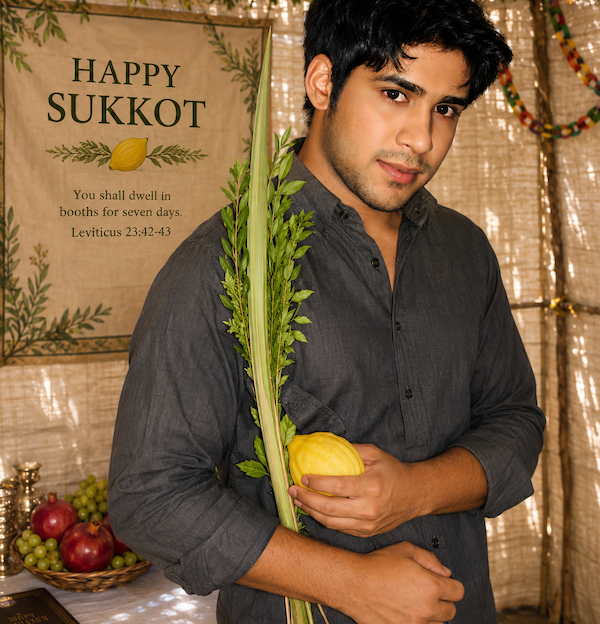
Sukkot, also known as the Feast of Tabernacles or Feast of Booths, lasts for seven days. During the festival, families live or spend time in a sukkah, a temporary shelter covered with greenery. This practice reminds Israel that God protected their ancestors as they traveled from Egypt to the Promised Land.
The Four Kinds also play an important role in the celebration. They symbolize the unity of God’s people and His presence everywhere. Following the solemn High Holy Days, Sukkot becomes a season of thanksgiving, joy, and celebration before the Lord.
How Sukkot Is Celebrated
The first two days of Sukkot (or one day in Israel) are Yom Tov, when God’s people refrain from regular work. Families light candles in the evening, recite Kiddush, and enjoy festive meals with challah dipped in honey.
Biblical Instructions for Sukkot
The Bible explains the observance of Sukkot in Leviticus 23:33–44, Nehemiah 8:13–18, and Zechariah 14:16–19.
“On the first day you shall take the fruit of majestic trees, branches of palm trees, boughs of leafy trees, and willows of the brook; and you shall rejoice before the Lord your God for seven days.” — Leviticus 23:40
“You shall live in booths for seven days; all that are citizens in Israel shall live in booths, so that your generations may know that I made the people of Israel live in booths when I brought them out of the land of Egypt: I am the Lord your God.” — Leviticus 23:42–43
“You shall keep the festival of booths for seven days, when you have gathered the produce from your threshing floor and your wine press. Rejoice in your festival… because the Lord your God will bless you in all your produce and in all your undertakings, so that you will surely have complete joy.” — Deuteronomy 16:13–15
The Sacrifices of Sukkot
Numbers 29:12–32 records the sacrifices for the Feast of Tabernacles. During the seven days, the number of bulls gradually decreases from thirteen on the first day to seven on the last day. The numbers of the other sacrificial animals remain unchanged.
Many Bible teachers see significance in the total of 70 bulls (13 + 12 + 11 + 10 + 9 + 8 + 7 = 70). Some interpret this number as representing the seventy nations described in Scripture. They also view it as a prophetic picture of God’s plan to extend salvation to all nations through the eternal Lamb. God foreshadowed this promise when He provided a ram in place of Isaac after stopping Abraham from offering his son.
A Lesson for Daily Living
Sukkot also offers practical lessons for everyday life. The decreasing number of bulls reminds some believers about moderation and healthy eating habits. A balanced approach encourages larger meals earlier in the day and lighter meals in the evening.
Modern research supports this pattern. Our bodies digest and metabolize food more efficiently during the morning and early afternoon. As the day continues, metabolism naturally slows. Studies suggest that the same meal may affect the body differently when eaten at 9:00 a.m. instead of 9:00 p.m. Although this health principle does not replace the biblical meaning of Sukkot, it illustrates how biblical patterns can encourage wise and disciplined living.