
God’s Principles Are the Key to Ending Slavery
Slavery was often legal and socially accepted in many societies, including Ancient Egypt, Greece, Rome, several African kingdoms, Islamic empires, and the colonial Americas. Enslaved people were treated as property, with little or no legal rights. Slavery was public and visible, slave markets, auctions, and forced labor were openly practiced. In some regions, including parts of the Middle East and North Africa, slavery continued openly into the 20th century.
A recent example of slavery re-emerging in its most brutal form occurred under the terrorist group Daesh (also known as ISIS or ISIL). Around mid-2014, Daesh and affiliated groups began the systematic abduction and sale of girls and women, primarily from the Yazidi minority. In August 2014, during attacks in Sinjar in northern Iraq, hundreds of Yazidi women and girls were kidnapped and subsequently sold into sexual slavery in Syria. The practice continued into 2015, and a “price list” for female and child slaves, ranging from one year old to fifty years old, was confirmed as genuine by a United Nations official. In June 2016, the UN officially recognized these actions as part of an ongoing genocide against the Yazidi people. The abduction and sale of women, referred to by the group as “Sabaya” (slaves), became a key strategy for attracting foreign fighters and generating profit.
Slavery and Ethical Treatment in the Holy Bible
Slavery existed throughout the ancient Near East, and the Bible reflects the social, economic, and legal realities of its time. The Bible does not abolish slavery in other nations, but it sets limits and rules for Israel. God gave His people moral protections and boundaries, beginning with the instruction that Israelites were not allowed to enslave their own fellow Israelites. If an Israelite became poor and had to sell himself, he was not to be treated as a slave but as a hired worker.
Leviticus 25:39–46 – 6000 Years Before
“If any of your fellow Israelites become poor and sell themselves to you, do not make them work as slaves. They are to be treated as hired workers or temporary residents among you; they are to work for you until the Year of Jubilee. Then they and their children are to be released, and they will go back to their own clans and to the property of their ancestors. Because the Israelites are my servants, whom I brought out of Egypt, they must not be sold as slaves. Do not rule over them ruthlessly, but fear your God.
Your male and female slaves are to come from the nations around you; from them you may buy slaves. You may also buy some of the temporary residents living among you and members of their clans born in your country, and they will become your property. You can bequeath them to your children as inherited property and can make them slaves for life, but you must not rule over your fellow Israelites ruthlessly.”
This passage shows that God prohibited the Israelites from enslaving their fellow Israelites, but allowed them to buy servants from surrounding nations, who sells slaves. This reflects the ancient context: in regions such as Egypt, Canaan, Mesopotamia, Assyria, and Babylon, slavery was widespread and socially accepted. These all nations are those who are now muslims, but promoted salvery in ancient times and in the modren times. Because the surrounding nations practiced slavery, God provided regulations so that Israel would not follow the harsh practices of other cultures, but instead treat people with dignity and set clear moral limits.
God recognized that Israel lived in a world where slavery was already deeply rooted in every major civilization (Egypt, Canaan, Mesopotamia, Assyria, and Babylon) while Israelites were a small family surrounded by other nations who worship foreign false and evil gods. Therefore, He placed strict protections for His own people, prevented Israelites from enslaving each other, and gave them laws to ensure more humane treatment than was common among other ancient nations.
Exodus 21:2 “If you buy a Hebrew servant, he shall serve six years, and in the seventh he shall go free.”
Exodus 21:26–27 “If an owner injured a slave’s eye or tooth, the slave was freed.
Exodus 21:7-11 “If a man sells his daughter as a servant, she is not to go free as male servants do. If she does not please the master who has selected her for himself, he must let her be redeemed. He has no right to sell her to foreigners, because he has broken faith with her. If he selects her for his son, he must grant her the rights of a daughter. If he marries another woman, he must not deprive the first one of her food, clothing and marital rights. If he does not provide her with these three things, she is to go free, without any payment of money.”
Deuteronomy 21:10–14 War captives could be taken as wives, but: they could not be sold, if dismissed, they must be set free.
Slavery and Ethical Treatment in the New Testament
The New Testament existed in the Roman Empire 2000 years before the modren world, where slavery was widespread. But The New emphasizes spiritual equality.
Ephesians 6:5 “Slaves, obey your earthly masters with respect and fear…”
Ephesians 6:9 “Masters, treat your slaves in the same way. Do not threaten them, since you know that he who is both their Master and yours is in heaven, and there is no favoritism with him.””
Galatians 3:28 “There is neither Jew nor Greek, slave nor free, male nor female, for you are all one in Christ Jesus.”
These Biblical teachings emphasize spiritual equality and the moral principle that slaves are not less than others in God’s eyes. Over time, these teachings influenced societies such as Rome, Greece, and eventually much of Europe, inspiring movements to fight against slavery. In Europe and the Americas, religious and philosophical advocates argued that slavery violated God-given human dignity. When the first Christian kingdoms embraced Biblical principles more fully, significant reforms followed: the British Empire abolished the transatlantic slave trade in 1807 and slavery itself in 1833, while the United States abolished slavery in 1865 through the 13th Amendment, following a long struggle that included civil war, activism, and advocacy.
The League of Nations was formed after World War I as part of the Treaty of Versailles in 1919. Its creation is most closely associated with U.S. President Woodrow Wilson, who proposed the idea in his Fourteen Points speech in 1918. Initially, 42 countries joined, including major Allied powers such as the UK, France, Italy, and Japan. Later, all Christian countries, along with other nations, helped establish the United Nations, which condemned slavery as a violation of human rights. International conventions, such as the 1926 Slavery Convention and the 1956 Supplementary Convention, legally abolished slavery worldwide.
Modern Slavery
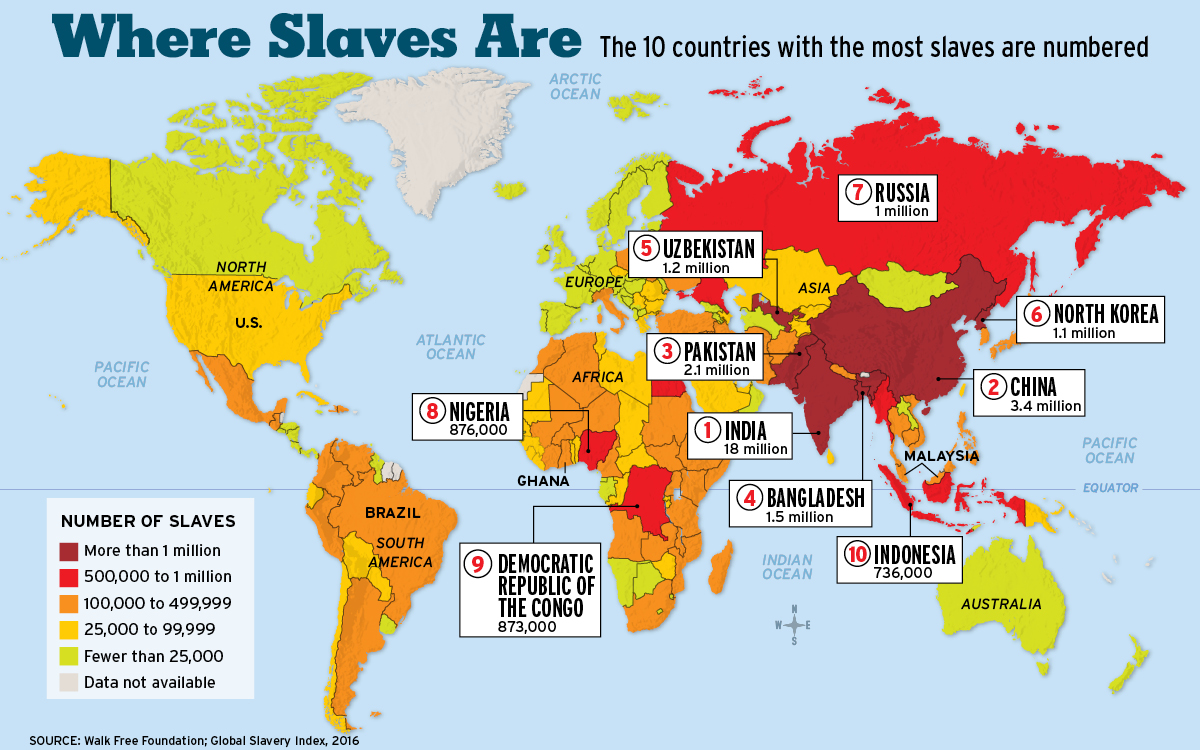
Modern slavery is illegal everywhere, yet it still persists in hidden and more complex forms. Although completely prohibited under international law, it continues secretly, often through criminal networks and exploitative practices. Victims may not even realize they are being enslaved due to coercion, threats, deception, debt bondage, or psychological manipulation.
Methods of Enslavement
- War captives
- Debt slavery
- Birth into slavery
- Kidnapping or raids
- – Modren Methods
- Human trafficking
- Forced labor
- Debt bondage (very common in parts of Asia, Africa, and the Middle East)
- Forced marriage
- Child labor and soldiering
- Domestic servitude
- Sexual exploitation
Slavery in the 21st Century in Muslims
Forced child marriage and the selling of young girls due to extreme poverty continue to occur in some regions, including parts of Afghanistan. In 2021, several reports—such as those published by Dawn News documented families selling their daughters to survive severe drought, displacement, and hunger.
Fahima, an Afghan mother, wept many times after her husband sold their two young daughters in order to keep the family alive during the drought in western Afghanistan. Nearby, six-year-old Faristeh and 18-month-old Shokriya sat beside her, unaware of what had happened.
Another father, Allahudin, a landless farmer, admitted:
“I sold my 10-year-old girl. I never would have done it if I had another choice.”
He said that desperation had pushed him to the brink, and he would consider selling his five-year-old if it meant the rest of the family could survive.
Forced child marriage is a cultural and economic problem, and it occurs in many contries.
Regarding historical context, some conservative scholars interpret certain Hadiths to mean that Aisha was very young when her marriage to Prophet Muhammad was arranged. This remains a subject of debate among historians and religious scholars. These muslims give refrences from Prophet Acts Sunnah: Sahih al-Bukhari, Book of Marriage (Kitab al-Nikah)
Hadith 5133 (and similar narrations 3894, 5081):
Narrated Aisha:
“The Prophet married me when I was six years old, and consummated the marriage with me when I was nine years old.”
Sahih Muslim, Book of Marriage – Hadith 1422:
Aisha reported:
“Allah’s Messenger married me when I was six years old, and I was taken to his house as a bride when I was nine.”
What is important today is that modern laws in Muslim-majority countries overwhelmingly prohibit child marriage, and many Islamic scholars strongly state that forced marriage and selling children are forbidden (haram) in Islam.
Slavery in Islam — Qur’an and Hadith References
Islamic law regulated slavery but did not abolish it. Slavery is abolished in Muslim countries in modern times through state legislation, not through the quran.
Quran An-Nisa 4:3 “If you fear you might fail to give orphan women their ˹due˺ rights ˹if you were to marry them˺, then marry other women of your choice, two, three, or four. But if you are afraid you will fail to maintain justice, then ˹content yourselves with˺ one or those ˹bondwomen˺ in your possession. This way you are less likely to commit injustice.”
Quran An-Nisa 4:24 “Also ˹forbidden are˺ married women, except female captives in your possession. This is Allah’s commandment to you. Lawful to you are all beyond these, as long as you seek them with your wealth in a legal marriage, not in fornication. Give those you have consummated marriage with their due dowries. It is permissible to be mutually gracious regarding the set dowry. Surely Allah is All-Knowing, All-Wise.”
Sahih al-Bukhari 4138 :
The Prophet permitted relations with female captives after ensuring they were not pregnant.
Ending slavery is not simply a social or political task, it is a moral one. Throughout history, God’s guidance has provided rules and principles to protect the vulnerable and ensure justice, from the laws given to the Israelites to the ethical teachings found in scripture.
Loyalty and Ethical Treatment in Holy Bible
Abraham and His Servant:
Abraham, one of the key figures in the Holy Bible, had servants whom he acquired as part of his household (Genesis 14:14; Genesis 15:2–3). One well-known story involves his servant Eliezer of Damascus, who played a central role in Abraham’s household. In Genesis 15:2–3, Abraham expresses concern about having no children and mentions that his servant will inherit his estate if God does not provide him a son. This indicates that the servant held a position of trust and responsibility.
Later, Abraham’s treatment of his servants demonstrates moral integrity and fairness. In Genesis 24, Abraham entrusts his servant with the important mission of finding a wife for his son Isaac. The servant is given clear instructions and freedom to act, showing the respect Abraham had for him. The servant successfully completes his mission, demonstrating his loyalty and trust in Abraham.
The narrative also illustrates that servants had the ability to exercise personal choice. In other traditions, Abraham is said to have offered freedom to his servants, yet they chose to remain with him, not because of coercion, but out of loyalty and trust. Abraham did not treat them harshly or exploit them; rather, he provided for their needs and respected their agency (see Genesis 24:34–38).
Key Principles from the Story:
- Ethical treatment of servants: Abraham acted with fairness, trust, and respect.
- Servants’ agency: Servants could make choices regarding their loyalty or freedom.
- Mutual loyalty: The relationship between master and servant could be based on trust and respect rather than fear.
- Divine guidance in household management: Abraham’s actions reflected God’s principles for treating people with dignity (Genesis 18:19).
Conclusion:
Slavery has existed throughout human history, from ancient civilizations to modern times, and it has taken many forms, legal, social, and hidden. While slavery was widespread in societies such as Egypt, Rome, Mesopotamia, and the Arabian world, religious texts and moral teachings consistently emphasized fair treatment, justice, and the dignity of human beings. The Bible forbidding Israelites from enslaving each other and encouraging humane treatment and protections for servants. Abraham’s example shows that even in a society where slavery existed, ethical treatment, respect, and personal choice were possible.
The story of Abraham and his servant shows that slavery or servitude in the Biblical context could include ethical treatment, trust, and personal choice. God’s laws and principles, as reflected in Abraham’s example, encouraged masters to act justly and honorably toward those under their care, setting a moral standard for human relationships even in a world where slavery was common.
Despite these teachings, slavery has persisted in various hidden forms, including human trafficking, forced labor, and child marriage, reminding us that laws alone are insufficient without moral vigilance. To truly overcome the injustice of slavery, we must embrace these values, living with compassion, fairness, and respect for every human being. We believe that just as Biblical teachings transformed Israel, Rome, Greece, the British Empire, and ultimately Europe and the Americas, these same teachings can now positively influence the lives of Muslims as well, with the support of the United Nations and other global forums.
“In God We Trust” is the official national motto of the United States, Declared by Congress in 1956, during the Cold War.
The quote Swords into Plowshares, referencing the verse Isaiah 2:4, appears on what’s known as the “Isaiah Wall” in a park (Ralph Bunche Park) across First Avenue from the UN Headquarters. The stained-glass window “Peace Window” by Marc Chagall in the UN building was reportedly inspired by the verse Isaiah 9:1-7
The preamble to the 1997 Constitution begins: “We, the Polish Nation — all citizens of the Republic, both those who believe in God as the source of truth, justice, good and beauty, as well as those not sharing such faith but respecting those universal values arising from other sources…”
The Swiss Constitution’s preamble begins with “In the name of Almighty God!” before stating the will of the people and the cantons.
The Irish Constitution invokes “the Most Holy Trinity” and addresses “our Divine Lord, Jesus Christ.”
Liberia, Its constitution’s preamble acknowledges gratitude to God, while establishing government for “unity, liberty, peace, stability, equality, justice and human rights.”
Peru, The 1993 constitution begins (in Spanish) with an invocation of “Almighty God.”
Paraguay, Its 1992 constitution begins with a similar invocation to God (“invocando Dios”).
Philippines, The 1987 constitution starts with “We, the sovereign Filipino people, imploring the aid of Almighty God…”
By aligning our actions with God’s standards, we not only honor His will but also create a world where freedom, dignity, and equality are realities for all.